Selecting a custom bending machine manufacturer represents one of the most critical equipment investments for precision manufacturing operations. With capital expenditures ranging from $100,000 to over $1 million for specialized systems, the decision extends far beyond initial purchase price. The right custom tube bending equipment partnership determines production capability, quality consistency, operational efficiency, and competitive positioning for years to come.
The landscape of engineered bending solutions has evolved significantly. Advanced CNC control systems, Industry 4.0 integration capabilities, and sophisticated tooling technologies now separate leading manufacturers from commodity suppliers. For engineering managers and procurement specialists evaluating options in 2026, understanding the technical evaluation criteria that truly matter becomes essential to making informed decisions.
Engineering Capability and Application Experience
The most fundamental criterion when evaluating a custom bending machine manufacturer is demonstrated engineering capability across your specific application requirements. Generic bending machine suppliers may offer standard equipment, but specialized bending machine manufacturers bring deep expertise in solving complex bending challenges.
Application-Specific Track Record
Examine the manufacturer’s documented experience within your industry sector. Aerospace applications demand different capabilities than oil and gas projects. A manufacturer serving NASA, military contractors, and commercial aerospace programs understands the documentation requirements, material traceability, and precision tolerances that these applications require. Similarly, petrochemical applications involve unique considerations around heavy-wall tubing, exotic alloys, and large-diameter pipe bending that not all manufacturers can address.
Request case studies and reference customers within your industry. Ask specific technical questions about how they’ve solved challenges similar to yours—whether that’s achieving tight bend radii in high-strength materials, maintaining wall thickness uniformity, or meeting specific industry certifications.
Custom Engineering Resources
Evaluate the manufacturer’s in-house engineering team depth. Custom CNC bending systems require more than catalog equipment selection—they demand application engineering, tooling design, process development, and ongoing technical support. Leading manufacturers employ mechanical engineers, metallurgists, and application specialists who can collaborate on solution development.
The engineering capability should extend to comprehensive process validation. Can the manufacturer provide bend simulation, springback analysis, and process documentation before production equipment delivery? This upfront engineering investment reduces risk and accelerates your production ramp-up.
Manufacturing Quality and American Production Standards
In 2026, supply chain considerations and manufacturing quality have become inseparable from equipment selection decisions. The country of manufacture directly impacts lead times, service responsiveness, regulatory compliance, and long-term parts availability.
Domestic Manufacturing Advantages
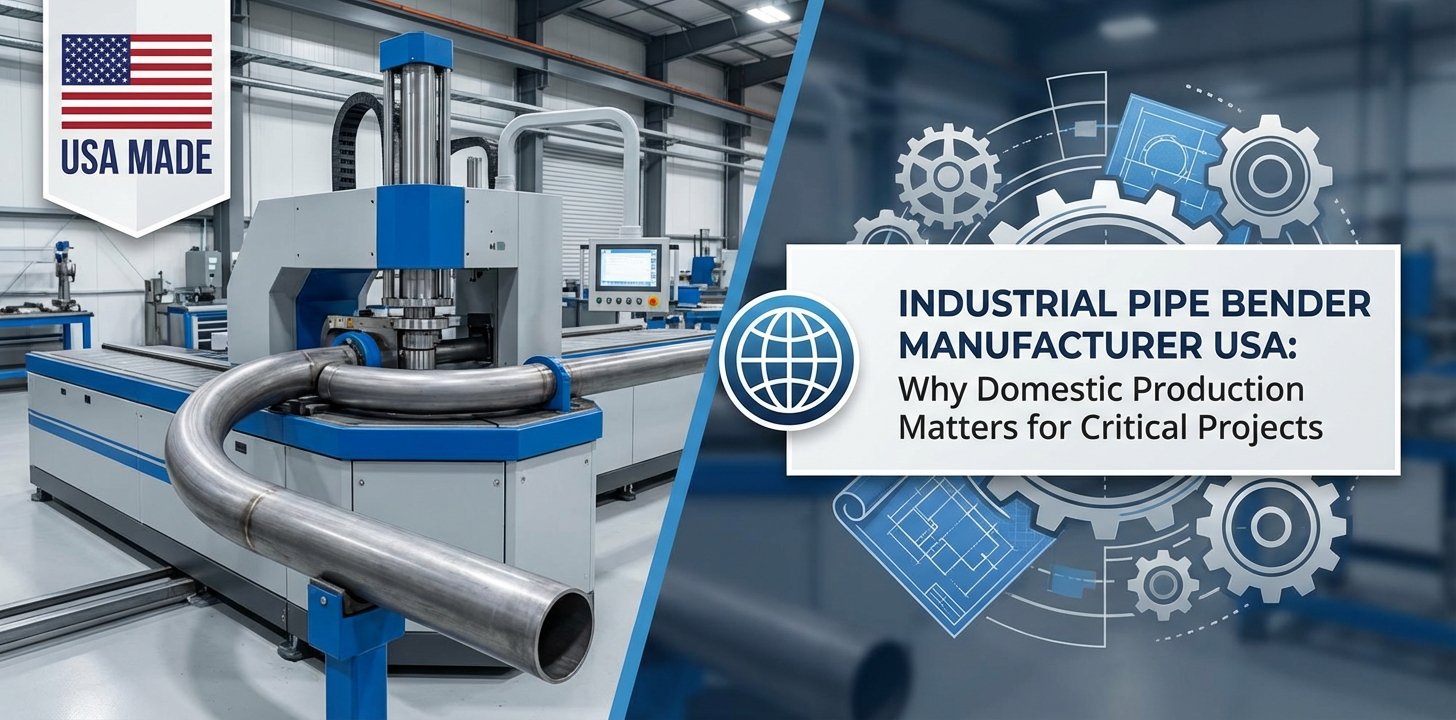
American-made bending equipment offers distinct advantages for critical applications. Domestic production means shorter lead times, easier factory visits during fabrication, simplified customs and import procedures, and enhanced intellectual property protection. For defense and aerospace applications, domestic content requirements may make American manufacturing mandatory rather than optional.
Manufacturing quality standards matter significantly. Equipment built to rigorous American manufacturing standards typically demonstrates superior build quality, precision machining, and longevity compared to imported alternatives. Examine the manufacturer’s quality management system—ISO 9001 certification represents baseline expectations, while AS9100 certification indicates aerospace-grade quality processes.
Component Selection and Sourcing
Investigate the critical components integrated into the bending system. Premium manufacturers specify industrial-grade servo motors, precision ball screws, hardened tooling materials, and robust structural components designed for decades of operation. Lower-cost alternatives often compromise on these fundamental elements, resulting in accelerated wear, reduced accuracy over time, and higher total cost of ownership.
Understand the supply chain for replacement parts and wear components. Manufacturers with long operational histories maintain parts availability for equipment decades old. This commitment to long-term support protects your capital investment and prevents premature obsolescence.
Technical Specification Analysis
Moving beyond marketing specifications to evaluate actual machine capabilities requires technical sophistication. The specifications that appear impressive in sales literature may not address your critical requirements.
Bending Capacity and Flexibility
Analyze bending capacity across multiple dimensions. Maximum tube diameter and minimum bend radius represent obvious specifications, but also evaluate wall thickness range, material hardness limits, and multi-plane bending capability. Custom tube bending equipment should accommodate your current requirements while providing growth capacity for future applications.
Flexibility matters increasingly in modern manufacturing. Can the machine handle both production runs and custom one-off projects? Does the tooling system allow rapid changeover between different tube sizes and bend configurations? Specialized bending machine manufacturers design systems with operational versatility that extends equipment utility.
Precision and Repeatability
Distinguish between accuracy specifications and real-world repeatability. A machine may achieve tight tolerances on initial setup, but repeatability—the ability to consistently reproduce those results across thousands of cycles—determines production quality and scrap rates.
Request actual capability studies from production equipment rather than theoretical specifications. Ask about typical tolerance ranges achieved in materials similar to yours. For aerospace and medical applications, position accuracy of ±0.005 inches and angle accuracy of ±0.1 degrees represent realistic expectations from precision equipment. Commodity machines rarely achieve this consistency in production environments.
Control System and Programming
Modern custom CNC bending systems incorporate sophisticated control technology that dramatically impacts operational efficiency. Evaluate the CNC platform for intuitive programming, simulation capabilities, and production monitoring features.
Advanced control systems offer parametric programming that automatically compensates for springback based on material properties, geometric programming that simplifies complex multi-plane bends, and diagnostic capabilities that enable predictive maintenance. Integration with CAD/CAM systems and manufacturing execution systems (MES) supports Industry 4.0 initiatives and data-driven process optimization.
Tooling Technology and Design
Tooling represents the interface between machine capability and actual part quality. A sophisticated machine with inadequate tooling cannot produce quality results, while optimized tooling maximizes equipment potential.
Evaluate the manufacturer’s tooling design approach. Do they employ finite element analysis to optimize bend die geometry? Can they provide custom tooling solutions for unique applications? The best engineered bending solutions include application-specific tooling designed to minimize deformation, prevent wrinkling, and achieve required surface finish.
Consider tooling flexibility and interchangeability. Modular tooling systems reduce changeover time and inventory requirements. Quick-change tooling mechanisms enable efficient production scheduling across diverse part families.
Training, Service, and Long-Term Support
Equipment capability matters little if your operators cannot effectively utilize it or if service support proves inadequate when issues arise. Comprehensive support distinguishes exceptional manufacturers from equipment vendors.
Operator Training Programs
Quality manufacturers provide structured training programs covering operation, programming, routine maintenance, and troubleshooting. Training should occur both during installation and through ongoing programs as staff changes occur. Evaluate whether training happens at your facility, the manufacturer’s location, or both.
Application development support extends beyond basic operation. Can the manufacturer’s technical team assist with process optimization, new application development, and quality troubleshooting? This partnership approach maximizes your equipment investment and accelerates capability development.
Service Responsiveness and Technical Support
Investigate the service infrastructure supporting your equipment investment. Domestic manufacturers with factory-direct service provide faster response times than importers relying on third-party service networks. For production-critical equipment, minimizing downtime through rapid service response directly impacts profitability.
Technical support accessibility matters daily. Can you reach knowledgeable applications engineers when questions arise? Remote diagnostic capabilities enable rapid troubleshooting without service visits. Extended service hours or 24/7 emergency support may justify premium investment for high-utilization operations.
Total Cost of Ownership Analysis
Purchase price represents only one component of equipment cost. Sophisticated procurement decisions evaluate total cost of ownership across the equipment lifecycle.
Consider operating costs including energy consumption, maintenance requirements, and consumables. Premium equipment with superior efficiency and durability often delivers lower operating costs that offset higher acquisition prices within 2-3 years.
Productivity differences dramatically impact cost justification. Equipment that reduces cycle time by 20% or improves first-pass yield by 10% generates substantial value. Quantify these operational advantages when comparing alternatives.
Residual value and equipment longevity factor into total cost analysis. Quality custom bending machine manufacturers build equipment that operates productively for 20-30 years with proper maintenance. This longevity reduces effective annual equipment cost and preserves resale value if future upgrades occur.
Regulatory Compliance and Certification
For regulated industries, manufacturer certifications and quality system compliance may determine eligibility rather than just preference. Verify that prospective manufacturers maintain certifications relevant to your requirements.
Aerospace suppliers typically require AS9100 certification. Defense applications may mandate ITAR registration and facility security clearances. Medical device manufacturing benefits from ISO 13485 compliance. These certifications demonstrate systematic quality management and support your own regulatory compliance obligations.
Making the Selection Decision
Comprehensive manufacturer evaluation requires balancing multiple technical and business factors. Create a weighted scoring matrix addressing engineering capability, manufacturing quality, technical specifications, support infrastructure, and total cost of ownership.
Factory visits provide invaluable insight unavailable through remote evaluation. Observe equipment under construction, meet engineering and service teams, and examine quality processes firsthand. These visits often reveal differentiating factors that specifications alone cannot communicate.
The custom bending machine manufacturer relationship extends decades beyond initial purchase. Select partners who demonstrate technical expertise, manufacturing excellence, and commitment to customer success. This partnership approach ensures your bending operations maintain competitive advantage through evolving market demands.
Hines Bending Systems has manufactured precision tube and pipe bending equipment in the United States for over six decades, serving aerospace, defense, energy, and industrial customers with engineered solutions and comprehensive support. Contact our applications engineering team to discuss your specific bending requirements and evaluate how our custom capabilities can support your manufacturing objectives.