The oil and gas industry operates under some of the most stringent quality requirements in manufacturing, and for good reason. A single compromised pipe bend in a high-pressure petrochemical facility can result in catastrophic failures, environmental disasters, and loss of life. As project specifications become increasingly complex and regulatory oversight intensifies, understanding how to meet API pipe bending standards isn’t just about compliance—it’s about ensuring operational integrity and safety across the entire energy infrastructure.
The Critical Role of API Standards in Pipeline Fabrication
The American Petroleum Institute (API) establishes the benchmark for oil and gas pipe bending quality worldwide. API standards like API 5L (line pipe specifications) and API 1104 (welding of pipelines) govern everything from material selection to dimensional tolerances, ensuring that bent pipe sections can withstand the extreme pressures, temperatures, and corrosive environments typical in energy applications.
In 2026, these standards have evolved to address new challenges including higher operating pressures in deep-water applications, more corrosive extracted materials from unconventional sources, and stricter environmental regulations. Pipeline bending requirements now demand not just dimensional accuracy but comprehensive documentation, material traceability, and quality assurance protocols that many conventional bending operations struggle to meet.
Understanding Pipeline Bending Requirements for Critical Applications
Oil and gas pipe bending differs fundamentally from general industrial bending. The stakes are higher, the materials more expensive, and the consequences of failure more severe. Several factors distinguish petrochemical pipe fabrication from other bending applications:
Material Specifications and Traceability
API standards require complete material traceability from mill certification through final installation. Carbon steel grades like X42, X52, X60, and X70 dominate pipeline construction, each with specific chemical compositions and mechanical properties. Higher-grade materials like X80 and X100 are increasingly common in high-pressure transmission lines where minimizing wall thickness reduces costs while maintaining pressure ratings.
The bending process must preserve these material properties. Excessive thinning on the extrados (outside radius), wrinkling on the intrados (inside radius), or work hardening that creates brittle zones can compromise pipe integrity. This is where process selection becomes critical.
Dimensional Tolerances and Ovality Control
API 5L specifies maximum ovality tolerances, typically limiting out-of-roundness to 3% of nominal diameter for line pipe. During bending, the cross-section naturally wants to deform into an oval shape due to the differential stresses between the compression and tension zones. Controlling this deformation requires proper tooling, mandrel support when necessary, and in many cases, specialized bending methods like induction bending.
Wall thickness variation presents another challenge. API standards typically allow minimal thinning on the extrados—often no more than 12.5% of nominal wall thickness. Cold bending operations struggle to meet this requirement on tight radius bends, while hot bending methods offer better control but introduce other considerations.
Induction Bending: The Gold Standard for Large Diameter Pipeline Work
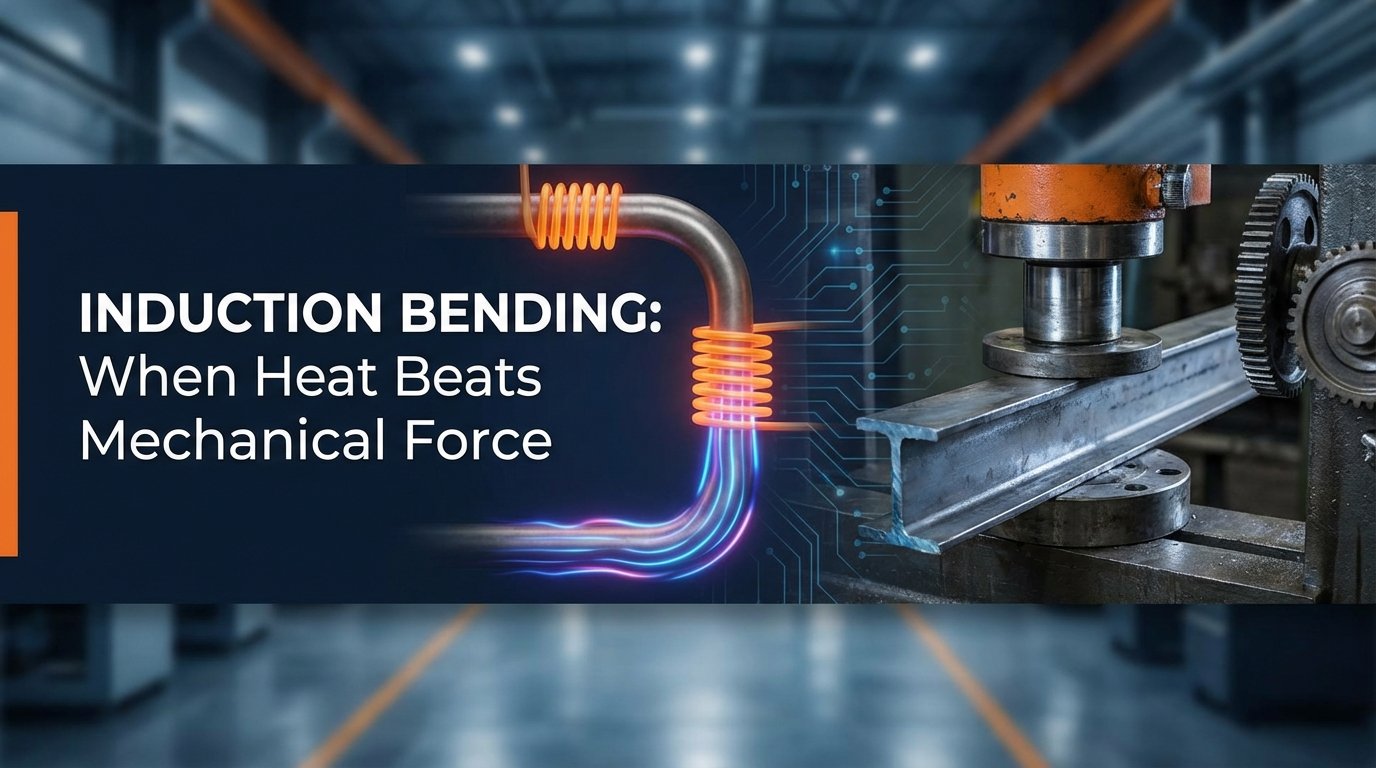
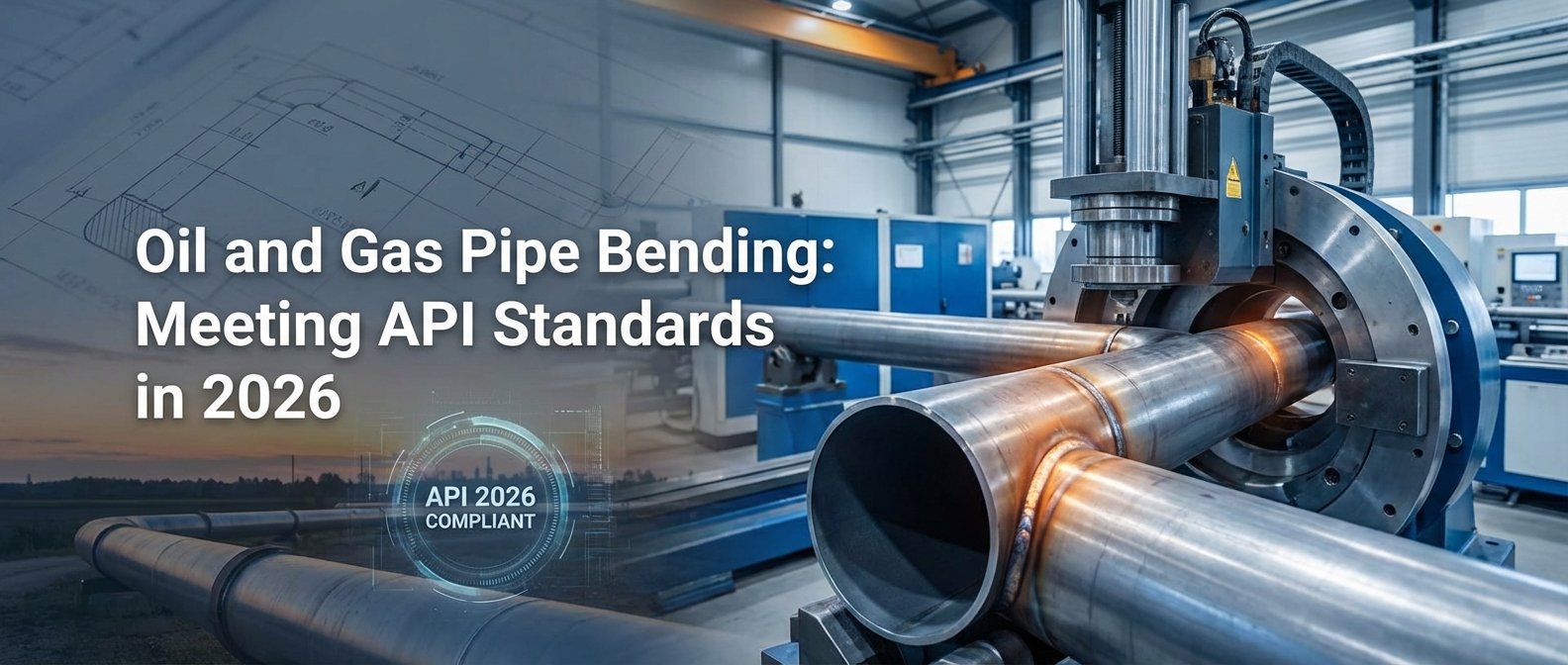
For large-diameter oil and gas pipe bending applications—typically 2 inches and larger—induction bending has emerged as the preferred method for meeting stringent API pipe bending standards. This process heats a narrow band of pipe using electromagnetic induction while simultaneously applying bending force and advancing the heated zone along the pipe length.
The advantages for pipeline applications are substantial:
- Superior ovality control: The localized heating and controlled cooling maintain cross-sectional geometry better than cold bending methods
- Minimal wall thinning: The heated material flows more readily, reducing the thinning effect on the extrados
- No wrinkling: Proper process control eliminates compression wrinkles on the intrados
- Excellent mechanical properties: Controlled heating and cooling cycles can actually improve grain structure
- Wide radius range: From 3D to 40D bends (where D equals pipe diameter) are achievable
Induction bending particularly excels with high-strength pipeline steels where cold bending would require excessive force and create unacceptable work hardening. The process allows bending of X80 and X100 grades while maintaining their specified properties—critical for modern high-pressure transmission systems.
Rotary Draw Bending for Precision Petrochemical Applications
While induction bending dominates large-diameter pipeline work, rotary draw bending remains essential for smaller diameter pipe and tube used throughout petrochemical facilities. Process piping, instrumentation lines, and complex manifold assemblies require the tight-radius, high-precision capabilities that rotary draw equipment provides.
Modern CNC rotary draw benders can hold tolerances within ±0.5 degrees on bend angles and ±0.030 inches on centerline radius—precision levels impossible with manual or hydraulic push bending methods. This accuracy matters tremendously when fabricating multi-bend assemblies where accumulated errors cause fit-up problems during installation.
For petrochemical pipe fabrication involving stainless steels, nickel alloys, and other corrosion-resistant materials, rotary draw bending offers excellent surface finish and minimal distortion. Using properly designed mandrels and wiper dies prevents wrinkling and collapse even on thin-wall tubing bent to tight radii.
Material Considerations in Oil and Gas Bending Operations
The materials encountered in oil and gas applications present unique challenges that demand specialized knowledge and equipment capabilities.
Carbon Steel Pipeline Materials
API 5L carbon steels constitute the bulk of pipeline construction. These materials generally bend readily, but higher grades (X70 and above) require careful attention to springback compensation and may need stress-relieving after bending to prevent stress corrosion cracking in service.
Sour service applications—where hydrogen sulfide is present—demand materials meeting NACE MR0175/ISO 15156 standards. The bending process must not introduce excessive hardness or residual stresses that could promote hydrogen-induced cracking.
Stainless and Duplex Stainless Steels
Offshore platforms and corrosive service applications increasingly specify stainless steels (304L, 316L) or duplex grades (2205, 2507). These materials work-harden significantly during cold bending, increasing springback and making angle prediction more challenging. They also require special attention to surface protection—scratches and contamination can initiate corrosion in service.
Nickel Alloys and Exotic Materials
High-temperature and highly corrosive applications may require Inconel, Hastelloy, or other nickel-based alloys. These expensive materials demand expert handling. Their high strength and work-hardening characteristics often necessitate hot bending or specialized tooling to achieve required geometries without material failure.
Quality Assurance and Documentation Requirements
Meeting API pipe bending standards extends far beyond the physical bending operation. Comprehensive quality assurance protocols document that every aspect of the process maintains specification compliance.
Typical documentation requirements include:
- Mill test reports (MTRs) for all material with heat number traceability
- Dimensional inspection reports showing all critical measurements
- Non-destructive testing (NDT) results when specified—often ultrasonic testing for wall thickness verification
- Heat treatment records if stress-relieving or other thermal processing is performed
- Procedure qualification records demonstrating the bending process meets requirements
- Welder qualifications if any welding accompanies the bending fabrication
Advanced fabrication facilities maintain comprehensive quality management systems certified to ISO 9001, with additional certifications like API Q1 specifically for oil and gas work. This infrastructure ensures consistent processes and reliable documentation.
Emerging Trends and Technologies in Pipeline Bending
The oil and gas sector continues evolving, driving new requirements for pipe bending capabilities. Several trends are reshaping how pipeline bending requirements are addressed in 2026:
Digitalization and Process Monitoring
Modern induction bending equipment incorporates real-time monitoring of heating temperatures, bending forces, and dimensional parameters. This data enables process optimization and provides objective quality records. Some advanced systems use machine learning algorithms to predict optimal parameters based on material properties and desired geometry.
Advanced Materials for Extreme Service
As drilling extends into deeper waters and harsher environments, material specifications continue advancing. Ultra-high-strength pipeline steels beyond X100 and corrosion-resistant alloys (CRAs) for sour service applications require bending capabilities that can accommodate their challenging properties while maintaining integrity.
Sustainability and Energy Transition
The energy transition creates new pipe bending applications in carbon capture, hydrogen transport, and renewable energy infrastructure. These emerging applications bring new material specifications and requirements while still demanding the quality and reliability established by oil and gas standards.
Selecting the Right Bending Partner for Critical Applications
Successfully meeting API pipe bending standards requires more than just equipment—it demands expertise, quality systems, and a commitment to excellence that comes from decades of experience in critical applications.
When evaluating pipe bending capabilities for oil and gas projects, consider these factors:
- Proven track record: Experience with similar materials, diameters, and specifications
- Quality certifications: ISO 9001 as baseline, with API Q1 or similar industry-specific credentials
- Engineering support: In-house expertise to assist with bend design, material selection, and process optimization
- Equipment capabilities: Modern, well-maintained bending equipment appropriate for your application
- Testing and inspection: On-site capabilities for dimensional verification and NDT when required
- American manufacturing: Domestic production often simplifies compliance, communication, and logistics
Make Your Next Pipeline Project a Success
Oil and gas pipe bending demands uncompromising quality, technical expertise, and rigorous adherence to API standards. Whether you’re specifying induction bending for large-diameter transmission lines or precision rotary draw bending for complex petrochemical assemblies, the right manufacturing partner makes the difference between project success and costly failures.
With decades of experience serving the energy sector and a proven track record with the most demanding applications, Hines Bending Systems provides both the equipment and expertise needed to meet your pipeline bending requirements. Our American-manufactured bending solutions have earned the trust of NASA, military contractors, and leading oil and gas companies worldwide.
Contact our engineering team today to discuss your specific application and discover how we can help you meet API pipe bending standards while optimizing your fabrication processes. Whether you need equipment, custom tooling, technical training, or expert consultation, we’re ready to support your success in this critical industry.