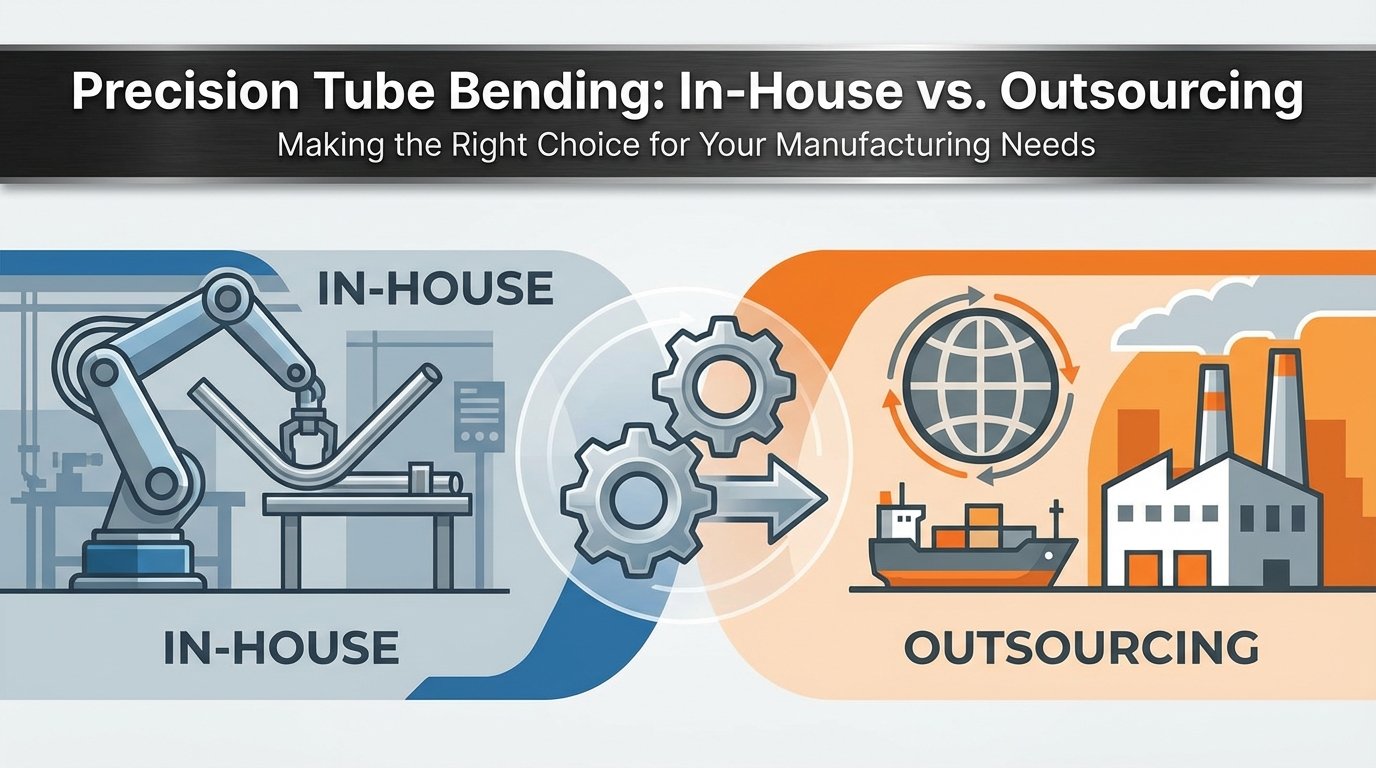
The decision between building internal tube bending capabilities or outsourcing production represents one of the most significant strategic choices facing manufacturing operations today. With precision tube bending manufacturer lead times fluctuating and supply chain reliability under constant scrutiny, engineering managers are reassessing their make-versus-buy strategies with fresh urgency in 2026.
This analysis cuts through the complexity by examining real operational costs, equipment capabilities, quality control factors, and strategic considerations that impact aerospace, energy, and industrial manufacturers. Whether you’re evaluating your first CNC tube bender or considering expansion of existing capabilities, understanding the true economics and operational implications drives better capital allocation decisions.
The Real Cost Analysis Beyond Equipment Price
Initial capital expenditure represents only a fraction of total ownership costs when establishing in-house tube bending capabilities. A comprehensive cost analysis must account for multiple operational factors that extend well beyond the purchase price of custom tube bending equipment.
Capital Investment Requirements
Modern CNC tube bender manufacturer equipment for precision applications typically ranges from $75,000 for entry-level machines to over $500,000 for fully automated systems handling complex aerospace geometries. However, the equipment itself represents approximately 60-70% of total setup costs.
Additional capital requirements include:
- Tooling packages specific to tube diameters, wall thicknesses, and bend radii ($15,000-$50,000 initially)
- Material handling systems for efficient loading and unloading operations
- Quality inspection equipment including CMM systems or optical measurement tools
- Environmental controls for temperature-sensitive precision work
- Safety equipment and workplace modifications meeting current OSHA standards
Operational Expenses Over Time
Recurring costs significantly impact the break-even analysis. Industrial tube bending machine sales professionals often focus on equipment capabilities while understating ongoing operational expenses that include:
Labor costs represent the largest operational expense. A skilled tube bending operator in 2026 commands $25-$45 per hour depending on regional markets and experience level. Unlike outsourcing where you pay only for active production, in-house operations require consistent staffing even during production valleys.
Maintenance and consumables add 8-12% annually to equipment costs. Mandrels wear, tooling requires replacement, hydraulic systems need service, and CNC controls require periodic updates. A precision tube bending manufacturer performing preventive maintenance maximizes uptime, but these activities consume both time and budget.
Floor space allocation carries real opportunity costs. A typical CNC bending cell requires 400-600 square feet including material staging and finished goods areas. At industrial facility costs of $8-$15 per square foot annually, this represents $3,200-$9,000 yearly in real estate costs.
Production Volume: The Critical Threshold
Break-even analysis depends heavily on production volumes and mix complexity. Manufacturing operations must honestly assess current and projected requirements rather than optimistic forecasts that never materialize.
When In-House Capabilities Make Economic Sense
In-house tube bending becomes financially attractive under specific conditions. Aerospace manufacturers producing 200+ bent assemblies monthly typically achieve payback within 18-24 months. The calculation improves dramatically when considering:
High-mix, low-volume production benefits most from internal capabilities. When producing 15-30 different part numbers monthly with runs of 10-50 pieces each, the flexibility of in-house equipment eliminates the constant quoting, scheduling, and logistics coordination required with external vendors.
Rapid iteration requirements during design and development phases justify equipment investment. Prototype development and engineering changes happen on your schedule rather than waiting in a tube bending equipment distributor’s production queue. This acceleration can compress product development timelines by 30-40%.
Integration with upstream and downstream processes creates operational efficiency. When tube bending represents one step in a larger assembly sequence, in-house control eliminates transportation delays, reduces handling damage risks, and simplifies production scheduling.
Outsourcing Advantages for Specific Scenarios
Outsourcing remains the optimal choice when production volumes fall below critical thresholds or requirements exceed available expertise. Companies producing fewer than 100 bent tubes monthly rarely justify equipment investment unless parts carry extraordinary margins or strategic importance.
Specialized materials or extreme specifications often favor outsourcing. Exotic alloys like Inconel 625, titanium 3Al-2.5V, or high-strength stainless grades require specific expertise and tooling. A precision tube bending manufacturer specializing in aerospace materials maintains the process knowledge and quality systems that occasional users cannot economically replicate.
Capacity overflow and surge requirements get handled cost-effectively through outsourcing partnerships. Rather than sizing internal equipment for peak demand that occurs 15% of the year, many operations maintain base-load capacity internally while outsourcing overflow to trusted partners.
Quality Control and Consistency Considerations
Quality outcomes depend less on whether work happens internally or externally than on process control maturity and measurement capabilities. Both approaches can deliver exceptional quality when properly executed.
In-House Quality Advantages
Direct oversight enables immediate corrective action when process drift occurs. Operators notice subtle changes in spring-back behavior, surface finish variations, or dimensional trends before they produce nonconforming parts. This real-time feedback shortens correction cycles from days to minutes.
Institutional knowledge accumulates with repetitive production. The operator who bends the same aerospace hydraulic tube for three years develops intuitive understanding that transcends written procedures. This expertise proves particularly valuable for materials exhibiting batch-to-batch variation requiring process adjustments.
Outsourcing Quality When Done Right
Specialized vendors often maintain superior process control compared to occasional users. A custom tube bending equipment manufacturer producing similar geometries across multiple customers develops refined processes, maintains comprehensive tooling libraries, and invests in quality systems that occasional users cannot justify.
Third-party certification and audit compliance come standard with established vendors. Aerospace and defense contractors requiring AS9100 certification, NADCAP accreditation, or military specifications often find outsourcing simpler than maintaining these credentials internally for limited production volumes.
Technical Capability and Complexity Factors
Equipment sophistication varies dramatically across industrial tube bending machine sales offerings. Understanding capability requirements prevents both over-investment in unnecessary features and under-specification that limits application potential.
Defining Your Technical Requirements
Bend radius capabilities determine feasible geometries. Centerline radius expressed as a multiple of tube diameter (CLR/D ratio) ranges from 1.0D for gentle bends to 3.0D+ for tight-radius applications. Tighter bends demand more sophisticated equipment, better tooling, and greater operator skill.
Wall thickness relative to diameter creates the D/t ratio that predicts wrinkling and collapse tendencies. Thin-wall tubing (D/t ratios above 30) requires mandrel support and precise control available only on advanced CNC systems. Companies regularly bending thin-wall aerospace tubing benefit from in-house capability investments.
Multiple-plane bending with close spatial tolerances challenges even experienced operators. When assemblies require bends in multiple planes with specific rotational relationships, CNC equipment with multi-axis control becomes essential. These capabilities carry premium costs that must align with application requirements.
Material-Specific Considerations
Different materials exhibit distinct bending characteristics affecting equipment selection and process development. Aluminum alloys bend readily but work-harden rapidly, requiring consideration of temper conditions and potential cracking in tight radii.
Stainless steel grades popular in petrochemical and food processing applications demonstrate higher spring-back requiring over-bend compensation. A precision tube bending manufacturer experienced with 316L stainless maintains empirical data enabling accurate first-piece success.
Titanium and high-temperature alloys used in aerospace exhaust systems and oil & gas downhole applications require specialized knowledge. Surface galling, work hardening, and extreme spring-back make these materials unforgiving of process errors.
Strategic and Operational Flexibility
Beyond pure economics, strategic considerations influence optimal approaches. Manufacturing strategy alignment, competitive positioning, and long-term capability development factor into decisions.
Intellectual Property and Confidentiality
Proprietary designs and competitive sensitivity sometimes mandate in-house production. While reputable vendors maintain confidentiality, companies developing breakthrough technologies may prefer eliminating external exposure entirely. Defense contractors working on classified programs face mandatory restrictions requiring cleared facilities.
Supply Chain Resilience
Recent supply chain disruptions elevated internal capability value beyond pure cost calculations. Aerospace manufacturers experiencing 8-12 week lead times for outsourced bent tubes recognized vulnerability. In-house capabilities provide resilience against external disruptions, though at carrying costs during normal operations.
Workforce Development Considerations
Maintaining advanced manufacturing skills within your organization creates long-term competitive advantages. Companies investing in tube bending capabilities develop cross-functional expertise applicable to related forming operations. This knowledge base proves difficult to rebuild once lost to outsourcing.
Making Your Decision: A Practical Framework
Effective decision-making requires structured evaluation rather than gut-feel judgments or anchoring on equipment costs alone.
Calculate your true annual volume across all part numbers. Include prototype work, sustaining engineering changes, and realistic growth projections. Conservative estimates prevent over-investment based on optimistic forecasts.
Assess technical complexity honestly against available expertise. A company with experienced metal forming engineers and skilled operators tackles in-house bending more successfully than organizations lacking this foundation.
Evaluate opportunity costs of capital. Money invested in tube bending equipment becomes unavailable for alternative uses. Companies with constrained capital may generate better returns investing in core differentiating capabilities while outsourcing commodity processes.
Consider hybrid approaches matching different product families to optimal production methods. High-volume standard products might run in-house while complex, low-volume specialties get outsourced to specialists. This balanced approach optimizes both cost and capability.
Frequently Asked Questions
What production volume justifies purchasing tube bending equipment?
Break-even typically occurs between 150-250 bent tubes monthly depending on complexity and material costs. Simple bends in common materials favor lower thresholds while complex aerospace geometries require higher volumes for justification.
How long does operator training require for precision tube bending?
Basic proficiency develops within 2-3 months for simple geometries. Advanced applications requiring tight tolerances in difficult materials may need 12-18 months before operators achieve consistent results. CNC equipment with automated setup reduces learning curves compared to manual machines.
Can outsourcing provide the same quality as in-house production?
Yes, when working with qualified vendors maintaining appropriate certifications and process controls. Quality depends more on process maturity than location. Many specialized tube bending equipment distributor operations exceed quality capabilities of occasional in-house users.
What maintenance requirements should I expect with tube bending equipment?
Plan for weekly lubrication, monthly inspection of wear components, and annual comprehensive service. Budget 8-12% of equipment cost annually for preventive maintenance, consumables, and periodic part replacement. Deferred maintenance causes exponentially higher costs through unexpected failures and quality issues.
Partner with Proven Precision Tube Bending Expertise
Whether you’re evaluating in-house equipment investment or seeking a reliable outsourcing partner, working with an experienced CNC tube bender manufacturer ensures success. For over four decades, manufacturers across aerospace, defense, energy, and industrial sectors have relied on American-made precision and engineering support for their most demanding applications.
Contact our engineering team to discuss your specific requirements, production volumes, and technical challenges. We provide objective guidance on equipment selection, capability assessment, and application engineering—helping you make informed decisions aligned with your operational and financial objectives.