Equipment acquisition represents just the starting point of operational excellence. A state-of-the-art CNC tube bender delivers maximum return on investment only when operated by skilled personnel who understand both the machine’s capabilities and the metallurgical principles governing precision bending. Companies investing six or seven figures in advanced bending equipment often underestimate the critical role that comprehensive operator training plays in achieving target cycle times, minimizing scrap rates, and extending tooling life.
The difference between a properly trained operator and one learning through trial and error can mean 30-40% higher scrap rates during the critical first year of equipment operation. For facilities processing high-value materials like titanium, Inconel, or specialized aerospace alloys, this knowledge gap translates directly to substantial financial losses and delayed production schedules.
The Hidden Cost of Inadequate Training
Manufacturing facilities frequently focus procurement discussions on machine specifications, delivery timelines, and initial purchase price while treating operator training as an afterthought. This approach creates predictable problems that emerge within weeks of installation.
Untrained operators struggle with fundamental challenges including springback compensation, mandrel selection for different materials and bend radii, proper lubrication protocols, and troubleshooting common defects like wrinkling, flattening, or wall thinning. Each failed part consumes raw material, machine time, and production capacity. More critically, operators without proper training often compensate by running equipment conservatively, dramatically reducing throughput and negating the productivity advantages that justified the capital investment.
Equipment damage represents another significant risk. CNC tube benders incorporate precision components including servo motors, ball screws, hydraulic systems, and expensive tooling assemblies. Operators unfamiliar with proper setup procedures can cause catastrophic tool crashes, damage mandrels worth thousands of dollars, or create maintenance issues that compromise machine accuracy for months.
Core Components of Effective Tube Bending Training Programs
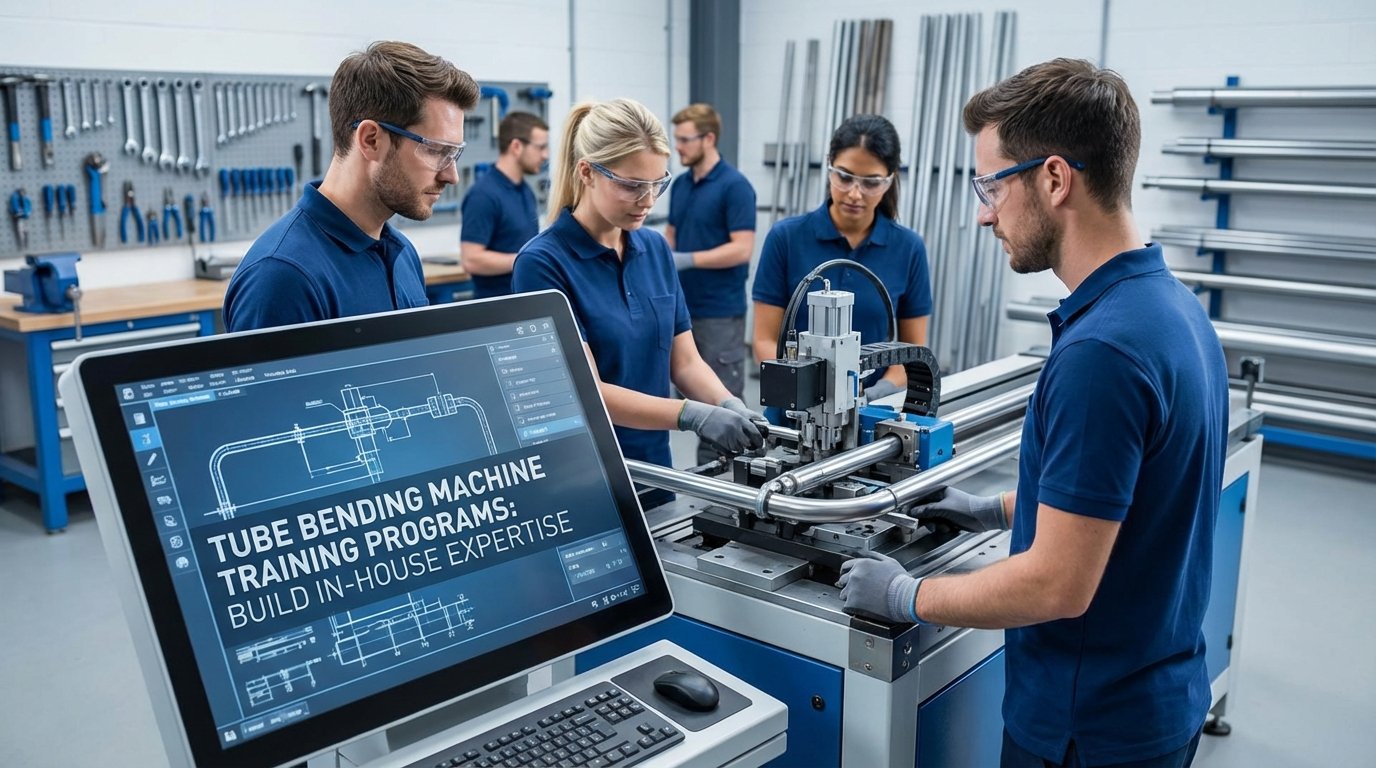
Comprehensive tube bending machine training programs address both theoretical knowledge and hands-on skill development. The most effective approaches combine classroom instruction covering metallurgical principles with extensive machine-side training using actual production parts.
Machine Operation Fundamentals
Initial training establishes proper operational procedures for specific equipment models. Operators learn machine startup and shutdown sequences, safety interlocks and emergency stop protocols, control interface navigation, and basic program execution. For CNC tube bender training, this phase emphasizes understanding the relationship between programmed parameters and actual bend geometry.
Trainees must develop proficiency with coordinate systems, bend sequence planning, and clamp positioning strategies. Modern CNC benders offer sophisticated features like automatic springback compensation and multi-stack bending capabilities that require systematic instruction to utilize effectively.
Material Science and Bend Mechanics
Understanding how different materials respond to bending forces separates competent operators from exceptional ones. Training programs should cover material properties affecting bendability including yield strength, ductility, and work hardening characteristics. Operators need practical knowledge of how wall thickness, bend radius, and material type interact to determine feasible bend geometries.
Mandrel bending training deserves particular emphasis for facilities processing thin-wall tubing or tight-radius bends. Proper mandrel selection, positioning, and extraction techniques prevent common defects while maintaining dimensional accuracy. Operators should understand when mandrel support is necessary versus when wiper dies or other tooling configurations provide adequate support.
Tooling Setup and Maintenance
Precision bending demands meticulous tooling setup. Training must cover bend die selection and installation, pressure die adjustment and timing, mandrel positioning relative to the point of tangency, wiper die clearance settings, and clamp die alignment procedures.
Operators should learn systematic approaches to tooling inspection, recognizing wear patterns that indicate adjustment needs or replacement requirements. Proper tooling maintenance extends service life dramatically while ensuring consistent part quality throughout production runs.
Process Development and Optimization
Advanced training enables operators to develop bending processes for new parts rather than simply executing pre-programmed routines. This includes bend sequence optimization to minimize springback accumulation, boost positioning strategies for complex multi-plane geometries, and speed and feed rate adjustment for different materials and geometries.
Operators trained in process optimization can reduce cycle times by 15-25% compared to baseline programs while maintaining quality standards. This capability proves especially valuable for facilities handling varied production mixes or frequent new part introductions.
Operator Skill Development Pathways
Structured skill development creates clear progression paths from novice to expert operator. This approach maintains consistent quality standards while providing employee development opportunities that improve retention.
Entry-level operators begin with basic machine operation, loading/unloading procedures, and quality inspection protocols. Intermediate operators develop proficiency in tooling changeovers, routine troubleshooting, and process parameter adjustment within established ranges. Advanced operators gain capabilities in process development, complex multi-bend programming, and training newer team members.
Facilities implementing formal pipe bending operator certification programs report improved quality metrics, reduced supervision requirements, and lower turnover among skilled personnel. Certification creates tangible recognition of expertise while establishing objective standards for different skill levels.
Industry-Specific Training Considerations
Different industrial applications demand specialized knowledge beyond general tube bending principles. Training programs should address the specific requirements relevant to primary production applications.
Aerospace Applications
Aerospace tube bending requires rigorous documentation, traceability, and adherence to specifications like AMS standards and customer-specific requirements. Operators need training in documentation protocols, material certification requirements, and inspection procedures using specialized equipment. Understanding tolerances measured in thousandths of an inch becomes critical when producing hydraulic lines, fuel systems, or structural components for aircraft.
Oil & Gas and Petrochemical
Energy sector applications emphasize material selection for corrosive environments, high-pressure ratings, and weld preparation requirements. Training should cover API standards, ASME B31.3 code requirements for process piping, and proper handling of large-diameter heavy-wall pipe. Operators must understand how bending affects material properties and pressure ratings.
High-Volume Production
Automotive and HVAC applications prioritize speed and repeatability. Training focuses on rapid tooling changeovers, statistical process control, and preventive maintenance schedules that maximize uptime. Operators learn to recognize trending quality issues before they result in production holds.
Implementing Continuous Learning Systems
Initial training represents just the foundation. Sustained operational excellence requires ongoing skill development and knowledge updates as equipment capabilities expand and production requirements evolve.
Regular refresher sessions reinforce tube bending best practices and introduce new techniques. When facilities add equipment capabilities through software updates or tooling enhancements, supplemental training ensures operators fully utilize new features.
Cross-training programs develop operational flexibility, allowing facilities to maintain production despite schedule variations or personnel changes. Operators gain broader perspective on how their work integrates with upstream and downstream processes, often identifying improvement opportunities that specialized personnel might overlook.
Documentation systems capture institutional knowledge, creating reference materials specific to facility equipment and typical production parts. Video recordings of complex setups, troubleshooting guides addressing common issues, and detailed process sheets preserve expertise even as workforce composition changes.
Selecting Training Partners and Resources
Equipment manufacturers typically offer the most relevant industrial bending equipment training because instruction focuses on specific machine models and control systems. Factory training provides direct access to engineering personnel who designed the equipment and understand its capabilities at the deepest level.
On-site training at customer facilities offers advantages for team training and allows instruction using actual production parts and materials. Operators learn in their working environment using the specific tooling configurations they’ll encounter daily. This approach minimizes travel costs and production disruption while maximizing knowledge transfer.
Factory training at manufacturing facilities exposes operators to advanced applications and specialized techniques. Trainees benefit from interaction with equipment engineers and exposure to capabilities they might not otherwise consider. For facilities investing in multiple machines or planning significant capability expansion, factory training provides strategic perspective beyond immediate operational needs.
Third-party training organizations and industry associations offer supplemental education covering industry standards, certification programs, and general tube bending principles. These resources complement manufacturer-specific training by providing broader context and networking opportunities with professionals facing similar challenges.
Measuring Training Effectiveness and ROI
Quantifying training impact demonstrates value and identifies areas requiring additional focus. Key performance indicators include first-pass yield rates comparing pre- and post-training performance, setup time reductions for tooling changeovers, cycle time improvements on established parts, and scrap rate trends over the first year of equipment operation.
Tracking these metrics establishes baseline performance and documents improvement trajectories. Facilities typically observe measurable improvements within 30-60 days of comprehensive training, with continued gains as operators accumulate experience applying learned principles.
Return on investment calculations should account for reduced scrap costs, improved equipment utilization, decreased supervision requirements, and extended tooling life resulting from proper operation. Most facilities find that comprehensive training programs deliver positive ROI within six months through scrap reduction alone, with additional value from productivity improvements and equipment longevity.
Building Long-Term Expertise
Strategic workforce development transforms tube bending operations from cost centers requiring constant oversight into competitive advantages generating consistent quality and productivity gains. Investing in people delivers returns that compound over years as experienced operators mentor newer employees, refine processes, and contribute insights that drive continuous improvement.
Facilities that view training as ongoing investment rather than one-time expense develop reputations for quality and reliability that translate to customer retention and premium pricing opportunities. When operational expertise becomes embedded in organizational culture, manufacturers gain flexibility to pursue complex projects that competitors cannot execute reliably.
Hines Bending Systems has trained thousands of operators across aerospace, energy, and industrial manufacturing applications over decades of American manufacturing excellence. Our training programs combine theoretical knowledge with practical application, delivered by engineers who understand both equipment capabilities and real-world production challenges. Whether you’re installing your first CNC tube bender or expanding existing capabilities, comprehensive training ensures your investment delivers maximum returns from day one.
Contact Hines Bending Systems to discuss customized training programs designed for your specific equipment, applications, and skill development objectives. Let’s build the expertise that transforms equipment investment into sustainable competitive advantage.