Production bottlenecks often stem from a mismatch between standard equipment capabilities and actual manufacturing requirements. When aerospace components demand tolerances within 0.001 inches, or petrochemical installations require exotic alloy processing, generic bending machines become expensive obstacles rather than solutions. The gap between what standard equipment offers and what specialized applications demand continues to widen as industries push the boundaries of material science and engineering precision.
Understanding when to specify custom bending equipment—and how to work with a specialized bending machine manufacturer to develop the right solution—separates efficient operations from costly compromises.
The Limitations of Standard Bending Equipment
Standard bending machines excel at common tasks within predictable parameters. They’re engineered for the middle 80% of bending applications: conventional materials, standard bend radii, moderate production volumes, and typical dimensional tolerances. This design philosophy makes commercial sense for mass-market equipment manufacturers.
However, several application characteristics immediately exceed standard machine capabilities:
- Exotic material processing: Titanium, Inconel, Hastelloy, and other high-strength alloys require specialized tooling, heating systems, and force calculations that standard machines cannot accommodate
- Extreme dimensional requirements: Aerospace and defense applications frequently specify tolerances of ±0.005 inches or tighter across multiple bend planes
- Complex geometries: Multi-plane bending with sequential operations, compound curves, or asymmetric profiles demand customized tooling strategies
- Unconventional tube specifications: Wall thicknesses, diameter-to-radius ratios, or cross-sectional shapes outside standard parameters
- Integration requirements: Automated production lines requiring specific footprints, control system compatibility, or downstream process integration
Each limitation represents not just a technical challenge but a business decision point. Attempting to force specialized work through standard equipment typically results in higher scrap rates, extended cycle times, secondary operations, and quality inconsistencies that undermine competitiveness.
Applications That Demand Engineered Bending Solutions
Aerospace and Defense Manufacturing
Aerospace applications exemplify the need for application-specific bending machines. Hydraulic tubing assemblies for flight control systems, fuel lines for aircraft engines, and structural components for airframes all share common requirements: traceability, repeatability, and absolute dimensional accuracy. Material certifications alone aren’t sufficient when a single out-of-tolerance bend can compromise system performance or safety.
NASA projects and military specifications often reference standards like AMS 2769 for bend quality and AS9100 for quality management systems. Meeting these requirements demands more than capable operators—the equipment itself must be engineered to deliver consistent results across production runs spanning months or years. Custom bending machine manufacturers serving this sector incorporate features like digital position feedback, automated measurement verification, and comprehensive data logging as baseline capabilities rather than optional accessories.
Oil and Gas Infrastructure
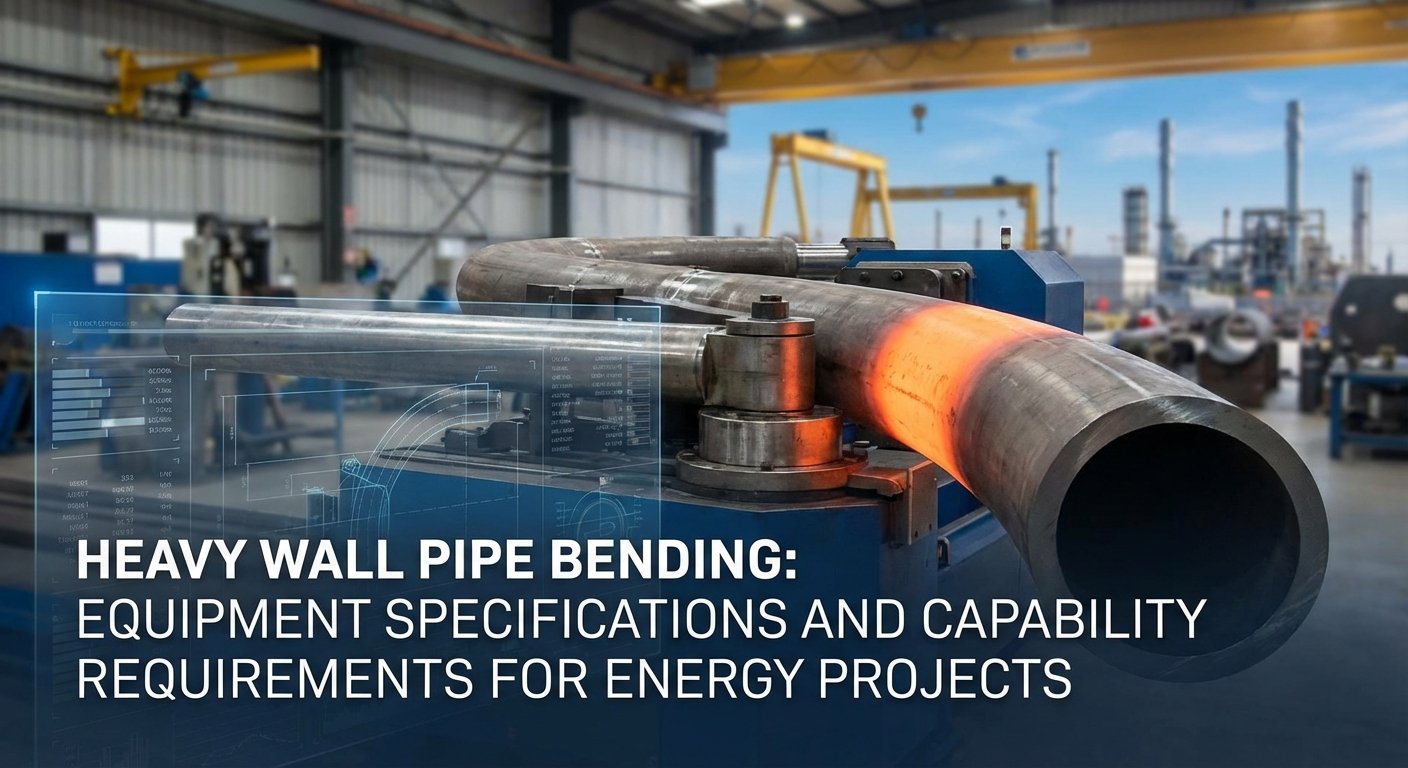
Offshore platforms, refinery installations, and pipeline systems present distinct challenges. Large-diameter pipe bending for process lines may involve 12-inch diameter schedule 80 pipe in corrosion-resistant alloys. The physical forces required exceed standard machine capacity, while installation tolerances remain critical for proper fit-up and welding.
Custom tube bending equipment for these applications often incorporates induction heating systems capable of bringing thick-walled pipe to forming temperature while maintaining metallurgical properties. Rotary draw bending with mandrel support prevents collapse, while specialized tooling accommodates the extreme forces involved. Some installations process pipe weighing several hundred pounds per linear foot—requirements that necessitate custom structural engineering and material handling systems.
Petrochemical Processing Equipment
Heat exchangers, reactor vessels, and process piping in petrochemical facilities combine corrosive environments, high pressures, and elevated temperatures. Tubing materials range from duplex stainless steels to nickel alloys, each with specific forming characteristics. Wall thickness variations, special end preparations, and non-destructive testing requirements add complexity.
A specialized bending machine manufacturer develops solutions accounting for the entire production workflow: material handling for 20-foot tube lengths, programmable heating zones for graduated bending, quick-change tooling for multiple bend radii within single assemblies, and integrated inspection stations for real-time quality verification.
High-Volume Automotive Production
While automotive applications might seem suited to standard equipment, high-volume exhaust system manufacturing or specialized chassis component production often requires custom automation. When producing 500 parts per shift with zero-defect quality expectations, the bending machine becomes part of an integrated manufacturing cell.
Custom solutions incorporate automatic loading from coil stock, multi-head bending for simultaneous operations, vision inspection systems, and robotic unloading. The equipment isn’t merely a bending machine but an engineered production system optimized for specific part geometries and cycle time requirements.
Engineering Custom Solutions: The Development Process
Effective custom bending equipment starts with comprehensive application analysis. A competent custom bending machine manufacturer begins by understanding not just what you’re bending, but why those specifications matter and how the equipment fits within broader production objectives.
Critical Specification Parameters
Material characteristics drive fundamental design decisions. Yield strength, elongation properties, work hardening behavior, and temperature sensitivity determine bending forces, tooling materials, and process control requirements. A material like 6Al-4V titanium behaves entirely differently from 304 stainless steel despite similar tensile strengths.
Geometric requirements define tooling strategy and machine configuration. Center line radius (CLR) relative to tube diameter, number and orientation of bends, and spatial relationships between features determine whether rotary draw, compression, or roll bending provides the optimal approach. Some geometries require hybrid processes combining multiple bending methods within a single machine.
Production volume and flexibility needs shape automation decisions. A defense contractor producing 50 units annually of 200 different part numbers requires different equipment than an automotive supplier running 10,000 identical parts weekly. Custom solutions balance throughput, changeover efficiency, and capital investment accordingly.
Control System Architecture
Modern engineered bending solutions incorporate sophisticated control systems managing multiple process variables simultaneously. Closed-loop position control, force monitoring, temperature regulation for heated bending, and quality data collection represent baseline functionality.
For applications requiring integration with enterprise systems, custom controllers support industry-standard protocols: OPC-UA for manufacturing execution system connectivity, Ethernet/IP for plant floor networks, and data export in formats compatible with statistical process control software. American manufacturing facilities increasingly demand this connectivity for Industry 4.0 initiatives and real-time production visibility.
Tooling Design and Materials
Tooling represents the interface between machine capability and part quality. Custom applications often require engineered tooling solutions addressing specific challenges: mandrels designed for thin-wall tubing in aerospace applications, pressure dies optimized for springback control in high-strength materials, or quick-change systems minimizing setup time for mixed-production environments.
Tool steel selection, heat treatment specifications, and surface coatings are engineered based on production volume expectations and material abrasiveness. A tool set processing Inconel 625 in a high-volume application requires different metallurgy than tools for occasional stainless steel bending.
Return on Investment Considerations
Custom bending equipment represents significant capital investment, justifiable when standard alternatives create ongoing operational costs. The ROI calculation extends beyond equipment price to encompass total cost of ownership.
Scrap reduction alone often justifies custom solutions. If standard equipment produces 8% scrap on a specialized application while an engineered solution reduces that to 0.5%, the material savings on expensive alloys generate measurable returns. For a production run processing $200,000 in raw material annually, scrap reduction saves $15,000 per year—potentially recovering equipment premiums within the useful life of the machinery.
Eliminated secondary operations provide additional value. When custom equipment delivers parts to final specification without subsequent straightening, end forming, or correction operations, labor costs decrease while throughput increases. The equipment investment replaces ongoing operational expenses.
Quality consistency reduces inspection burden and liability exposure. Aerospace and defense suppliers understand that delivering suspect parts carries costs far exceeding scrap value: investigation time, customer notifications, potential fleet-wide inspections, and reputational impact. Equipment engineered to prevent defects rather than merely detect them provides risk mitigation value beyond simple financial calculations.
Selecting a Custom Bending Machine Manufacturer
Engineering capability separates true custom manufacturers from companies that modify standard products. Evaluate potential partners on their ability to analyze your application from first principles, not merely their catalog offerings.
Proven performance in demanding applications provides confidence. A manufacturer’s track record with NASA, military primes, or major energy companies demonstrates capability to meet rigorous specifications and support long-term production requirements. American manufacturing heritage often correlates with understanding of domestic quality standards and support expectations.
Comprehensive support infrastructure matters for specialized equipment. Custom machines require manufacturers who provide applications engineering assistance, operator training, preventive maintenance programs, and responsive technical support. When equipment represents a production bottleneck, downtime costs escalate rapidly—manufacturer support capabilities directly impact operational reliability.
Implementation and Long-Term Success
Successful custom equipment deployment extends beyond installation and startup. Comprehensive operator training ensures personnel understand not just how to run the machine but why specific parameters matter and how to recognize early indicators of tool wear or process drift.
Documentation should include detailed process specifications, tooling drawings, maintenance procedures, and troubleshooting guides. For regulated industries, this documentation becomes part of quality system records demonstrating process control and validation.
Establishing preventive maintenance schedules and spare parts inventory prevents unplanned downtime. Custom equipment may incorporate specialized components requiring longer lead times than standard parts—proactive planning maintains production continuity.
Moving Forward with Custom Solutions
When production requirements exceed standard equipment capabilities, custom bending solutions transform constraints into competitive advantages. The key lies in partnering with a specialized bending machine manufacturer who approaches your application as an engineering challenge rather than a sales opportunity.
Success requires clear communication of requirements, realistic timeline expectations, and commitment to the development process. The result—equipment precisely matched to application demands—delivers quality, efficiency, and capabilities unavailable through compromise solutions.
If your bending applications demand precision beyond standard equipment capabilities, specialized materials expertise, or integration within complex production systems, exploring engineered solutions makes strategic sense. Contact Hines Bending Systems to discuss your specific requirements with engineers who have delivered custom bending solutions for the most demanding applications in aerospace, defense, energy, and industrial manufacturing. Our American-made equipment and comprehensive support infrastructure ensure your investment delivers long-term production success.