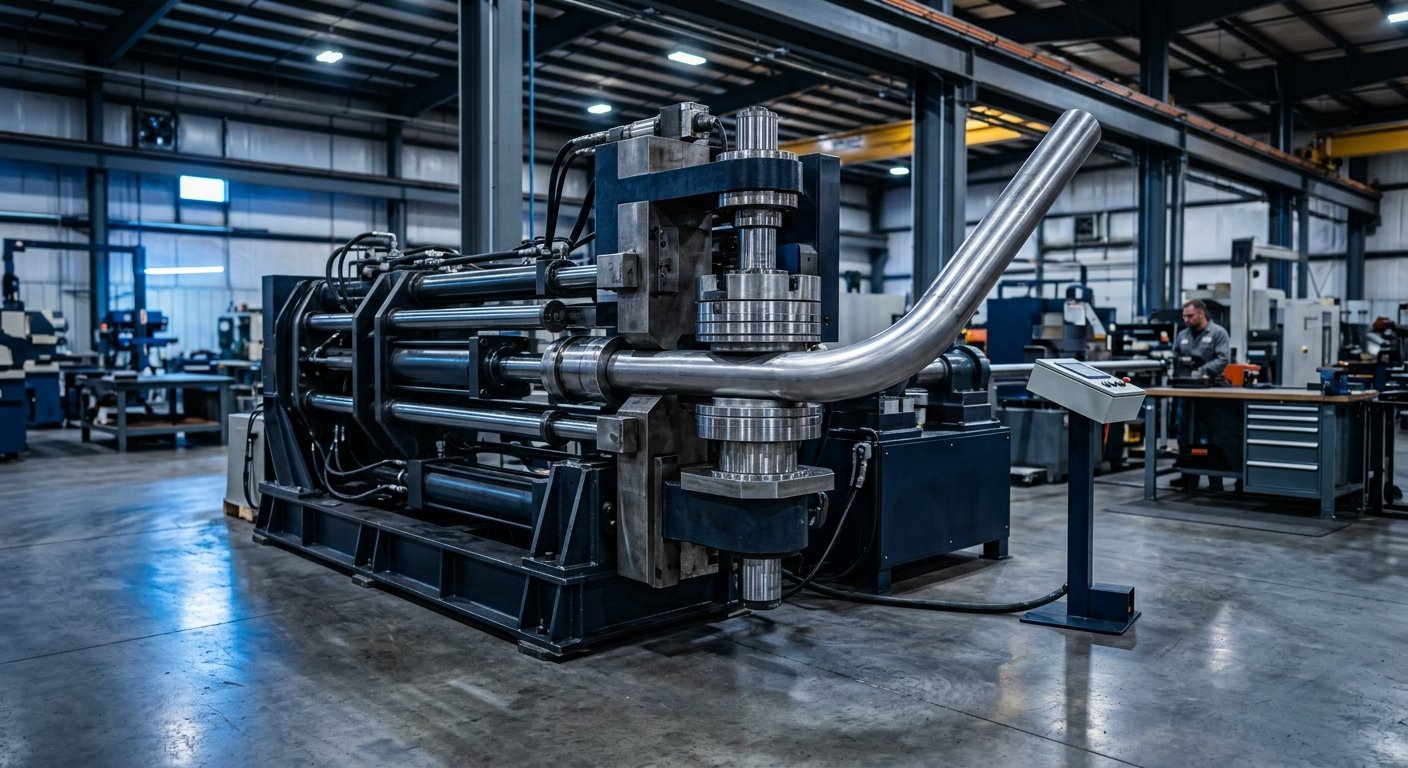
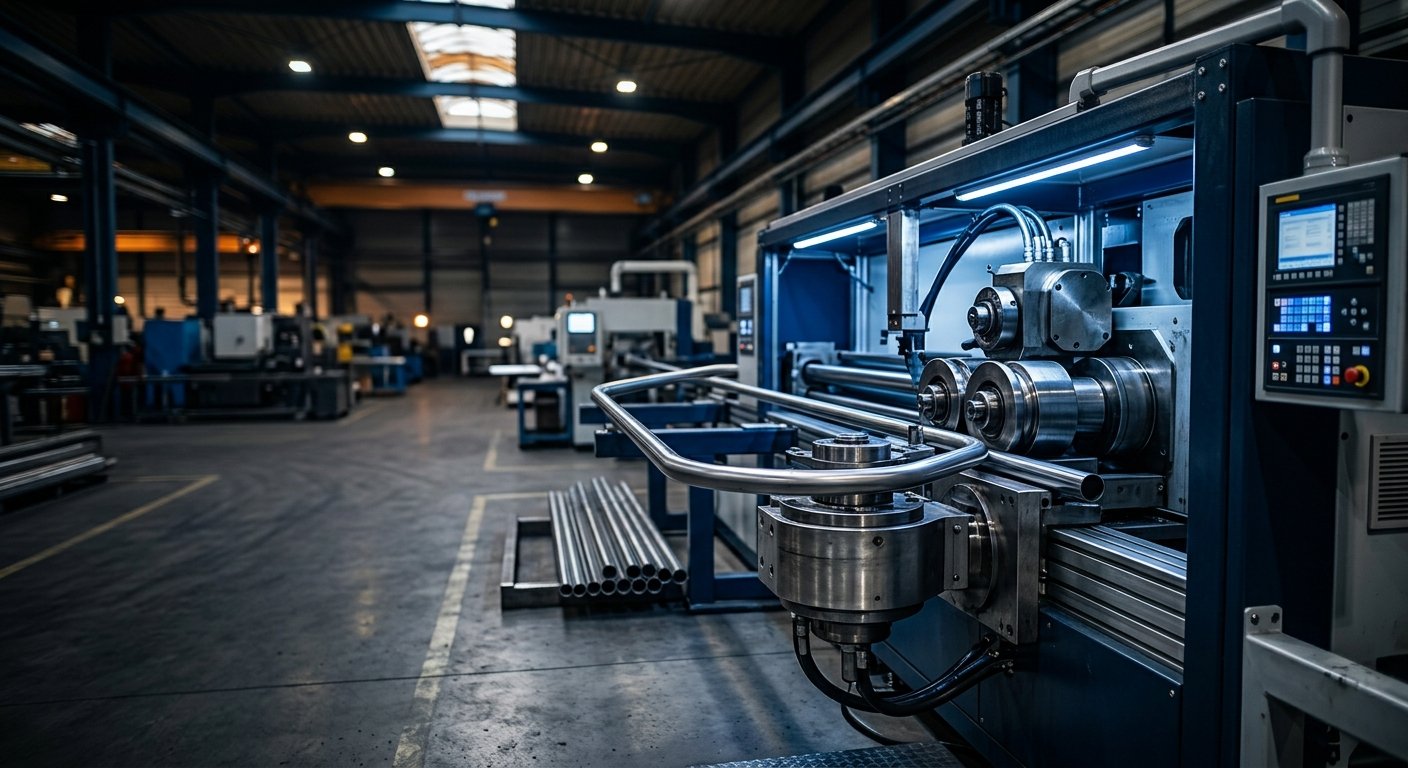
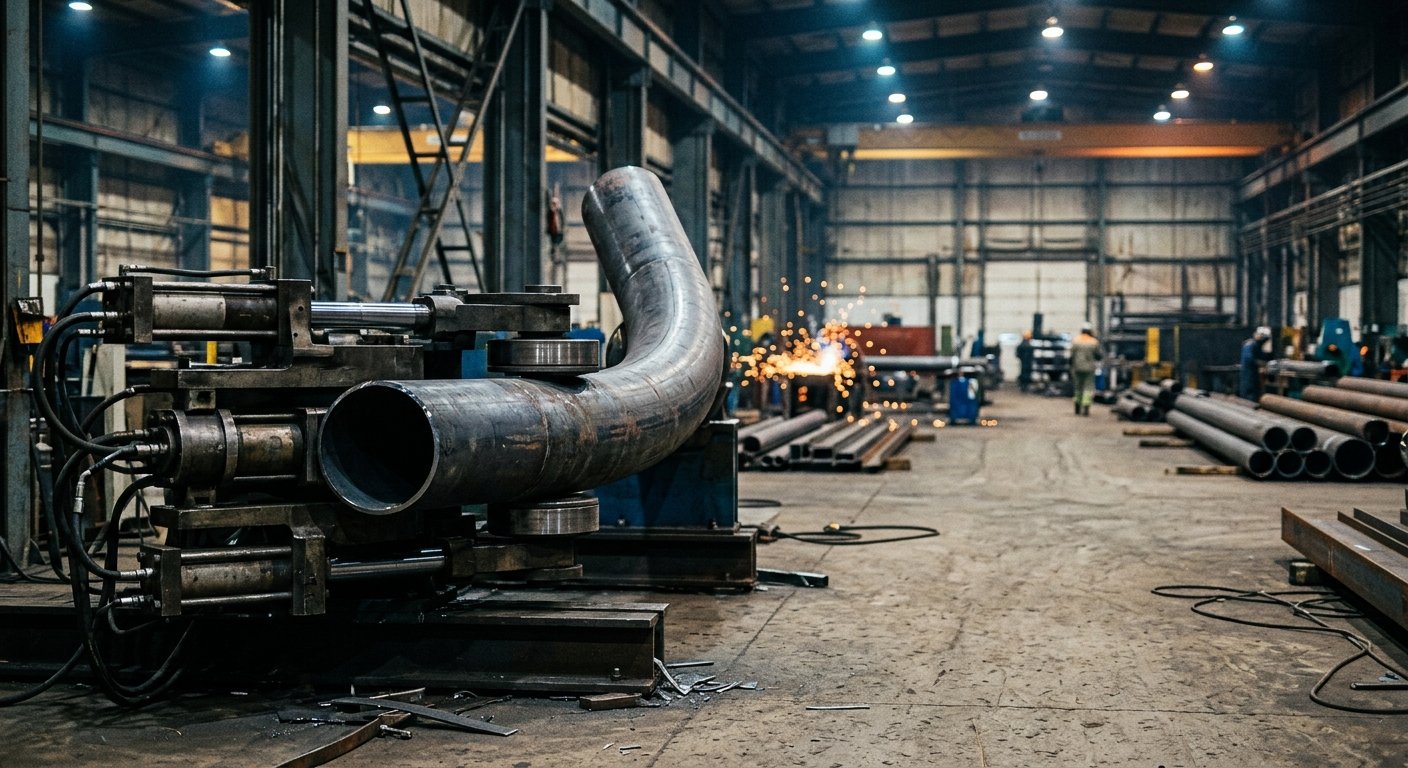
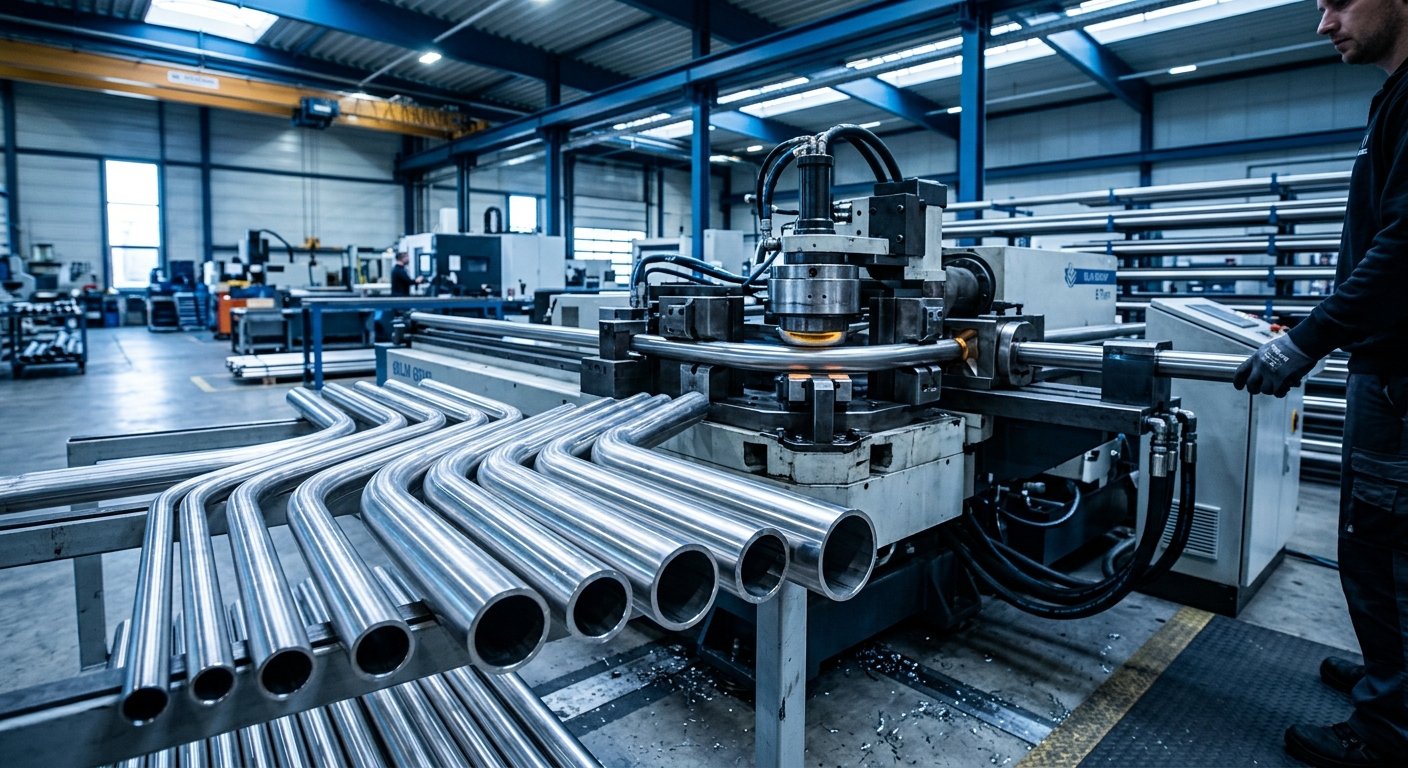
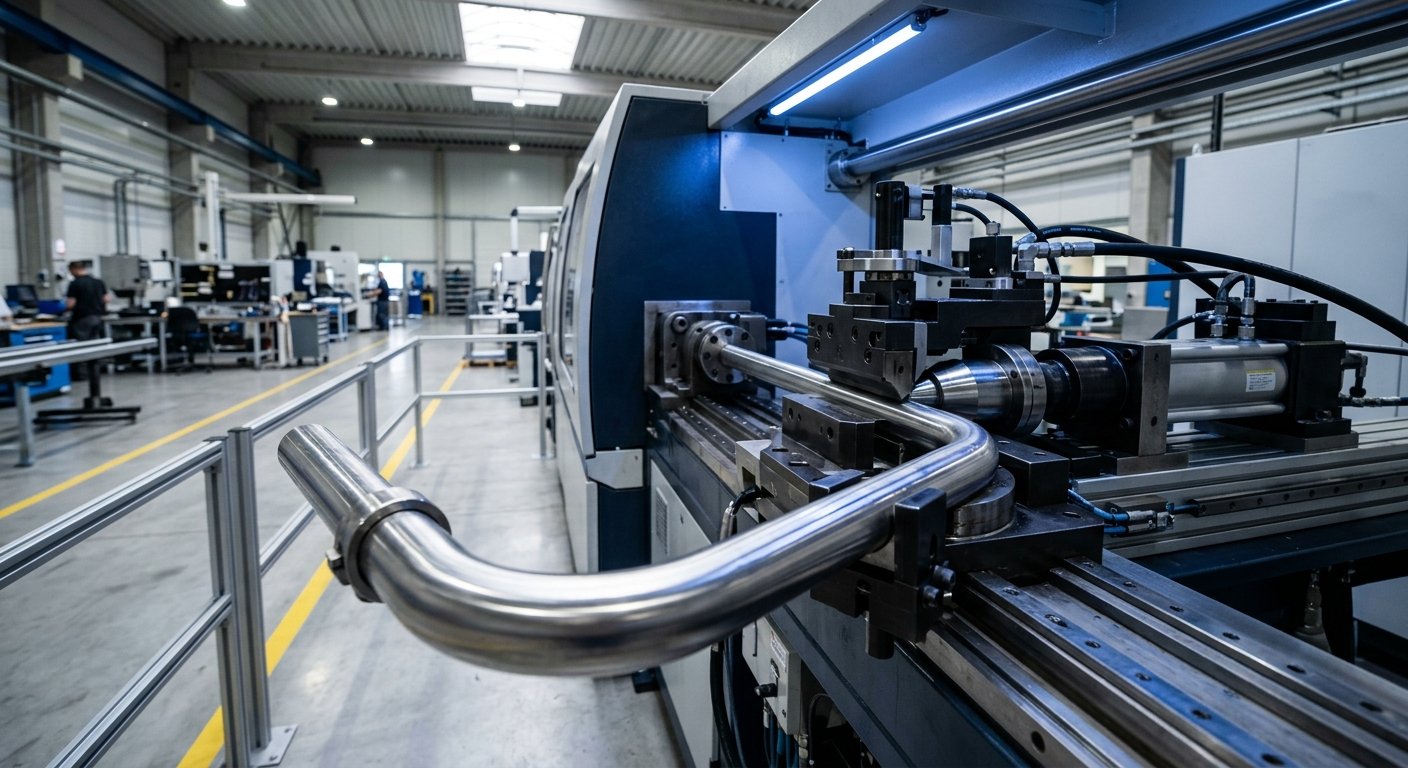
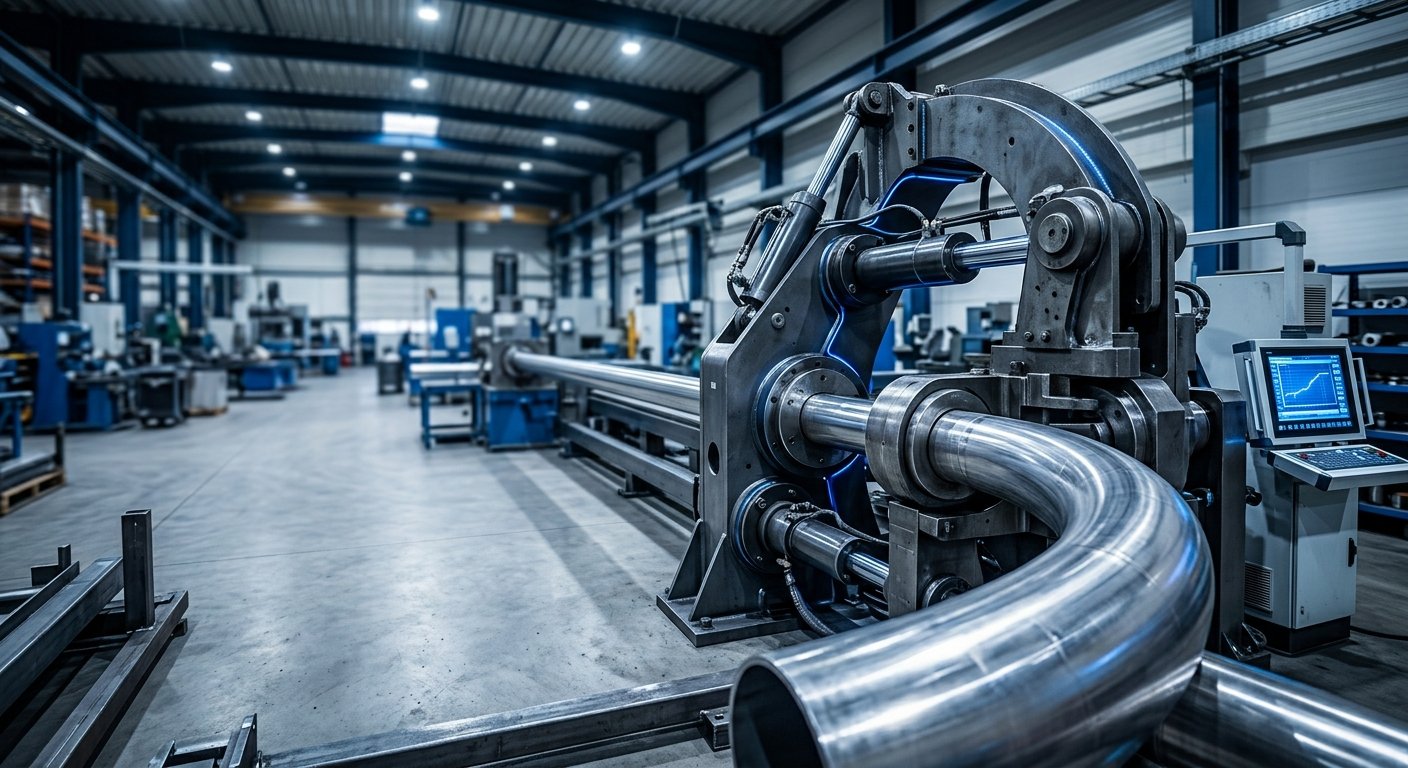
Selecting the right CNC pipe bender manufacturer in 2026 requires navigating advanced automation capabilities, increasingly stringent precision requirements, and the growing demand for American-made equipment that can handle complex geometries across multiple industries. Today’s precision pipe bending manufacturer must deliver not just machinery, but complete solutions that integrate seamlessly with modern production environments while meeting the exacting standards of aerospace, defense, and energy sectors.
The industrial pipe bending equipment manufacturer landscape has evolved dramatically. What once centered on basic hydraulic systems now encompasses servo-electric drives, real-time process monitoring, adaptive bending algorithms, and Industry 4.0 connectivity. For engineering managers tasked with specifying equipment that will serve demanding applications for decades, understanding these technological advances isn’t optional—it’s essential to making a sound capital investment.
Critical Technology Capabilities in Modern CNC Pipe Benders
When evaluating a cnc pipe bender manufacturer, the technology stack extends far beyond simple axis control. Today’s systems integrate multiple advanced capabilities that directly impact production quality, throughput, and operational flexibility.
Servo-Electric vs. Hydraulic Drive Systems
The shift toward all-electric bending systems represents one of the most significant technological advances in the past five years. Servo-electric drives offer repeatability within ±0.1 degrees across thousands of cycles, consuming 40-60% less energy than comparable hydraulic systems while eliminating concerns about fluid contamination or temperature-dependent performance variations.
However, hydraulic systems retain advantages for specific applications. When bending heavy-wall pipe in materials like Inconel 625 or duplex stainless steel, hydraulic systems provide sustained high-force capability without the thermal management challenges that can affect electric servo motors during extended high-load operations. Leading custom pipe bending machines manufacturers now offer hybrid configurations that leverage electric precision for positioning and measurement while maintaining hydraulic power for the bending operation itself.
Adaptive Bending and Springback Compensation
Material springback remains one of the primary challenges in precision pipe bending. Advanced CNC systems in 2026 employ real-time measurement during the bending process, using laser or optical sensors to track actual tube position. This data feeds adaptive algorithms that automatically adjust bending parameters to compensate for material variations within a single production run.
For aerospace applications working with 6Al-4V titanium or precipitation-hardened stainless steels, this capability is transformative. Rather than requiring multiple test bends and manual program adjustments, the system learns material behavior and makes corrections autonomously, reducing setup time by 60-70% while improving first-part yield rates.
Multi-Stack and Multi-Radius Capability
Production flexibility increasingly demands machines capable of multiple bend radii without tooling changes. Modern multi-stack benders accommodate three or more bend die sets simultaneously, allowing rapid transitions between different radii within a single part program or across different production runs.
This capability proves particularly valuable in oil & gas applications where a single manifold assembly might require 1.5D, 2D, and 3D bends in the same component. A precision pipe bending manufacturer offering true multi-stack capability eliminates the production bottlenecks and quality risks associated with moving parts between different machines for various bend radii.
Material Considerations and Specialized Bending Requirements
The pipe bending machine manufacturer you select must demonstrate proven capability with your specific materials. Material behavior during bending varies dramatically, and equipment optimized for mild steel won’t necessarily perform adequately with exotic alloys or thin-wall tubing.
Exotic Alloys and High-Strength Materials
Aerospace and petrochemical applications frequently specify materials like Inconel 718, Hastelloy C-276, or duplex 2205 stainless steel. These alloys present significant work hardening characteristics and require substantially higher bending forces than carbon steel of equivalent dimensions.
A qualified industrial pipe bending equipment manufacturer should provide specific force calculations and demonstrate previous successful applications with your target materials. For example, bending 2-inch schedule 40 Inconel 718 to a 3D radius requires approximately 180,000 pounds of force and specialized tooling with surface treatments to prevent galling—capabilities not found in general-purpose equipment.
Thin-Wall Tubing and Ovality Control
Aircraft hydraulic systems, medical gas distribution, and advanced heat exchangers often use thin-wall tubing where wall thickness-to-diameter ratios approach 0.015 or less. Maintaining acceptable ovality (typically less than 8% diameter variation) while preventing wrinkling demands sophisticated tooling design and precise control of mandrel pressure, wiper die clearances, and bending speed.
Manufacturers offering custom pipe bending machines should provide sample bends in your specific material and wall thickness before final equipment specification. Request documentation of achieved ovality, wall thinning on the extrados, and thickening on the intrados to verify the equipment can meet your dimensional requirements.
Industry-Specific Application Requirements
Different industries impose unique requirements that affect manufacturer selection beyond basic bending capability.
Aerospace and Defense Standards
Equipment serving aerospace applications must support full traceability, including documentation of calibration records, material certifications, and process parameters for every bent component. Many programs require compliance with AS9100 quality systems, and the cnc pipe bender manufacturer should maintain appropriate certifications.
NASA and military programs frequently specify American-made equipment with domestic supply chains for critical components. Manufacturers with proven track records supplying these sectors understand documentation requirements, security protocols, and the long-term parts and service support necessary for programs spanning decades.
Oil & Gas and Petrochemical Processing
High-pressure piping systems for refineries, offshore platforms, and petrochemical plants demand absolute dimensional accuracy and full-penetration weld preparation. Bends must meet ASME B31.3 requirements, often requiring post-bend heat treatment for stress relief.
For these applications, equipment must accommodate large-diameter heavy-wall pipe—often 6 to 12 inches with schedule 80 or XXH wall thickness. The precision pipe bending manufacturer should offer equipment with sufficient daylight (throat depth) and tonnage capacity while maintaining the accuracy required for fit-up with flanges, valves, and other piping components.
High-Volume Automotive and Construction Applications
Roll cage fabrication, exhaust systems, and structural tubing applications prioritize cycle time and operational simplicity. These industries benefit from machines optimized for rapid setup, intuitive programming interfaces, and robust construction that maintains accuracy across millions of cycles.
While aerospace applications might produce 50-200 parts monthly with frequent changeovers, automotive suppliers may run tens of thousands of identical parts. This fundamental difference affects ideal machine configuration, tooling design, and automation integration requirements.
Evaluating Manufacturer Capabilities Beyond the Machine
The equipment itself represents only part of the total value proposition. Long-term success depends equally on the manufacturer’s support infrastructure, engineering expertise, and commitment to customer success.
Applications Engineering and Process Development
Complex bending applications require genuine engineering support, not just sales assistance. The pipe bending machine manufacturer should offer applications engineering services that include feasibility analysis, tooling design recommendations, and process parameter development.
For challenging projects—perhaps multi-plane bends in titanium with minimal straight sections between bends—preliminary analysis should address potential issues like mandrel extraction, clocking accuracy between bends, and achievable tolerances before you commit to equipment purchase.
Training and Ongoing Technical Support
CNC pipe benders represent sophisticated equipment requiring trained operators and maintenance personnel. Comprehensive training programs should cover machine operation, programming, tooling setup, preventive maintenance, and troubleshooting procedures.
Evaluate whether training occurs at the manufacturer’s facility with hands-on instruction, includes your actual production parts, and provides ongoing access to technical support. Domestic manufacturers typically offer superior responsiveness compared to overseas suppliers where time zones and language barriers complicate communication.
Parts Availability and Service Network
Equipment downtime directly impacts production schedules and customer commitments. A qualified industrial pipe bending equipment manufacturer maintains comprehensive parts inventory for immediate shipment and either employs factory-direct service technicians or maintains a network of trained service partners.
For critical production environments, investigate service response times, parts availability guarantees, and whether the manufacturer offers preventive maintenance contracts or remote diagnostic capabilities that identify potential issues before they cause unplanned downtime.
American Manufacturing and Supply Chain Considerations
In 2026, supply chain resilience and domestic manufacturing capability carry greater weight in capital equipment decisions than in previous decades. Recent disruptions highlighted vulnerabilities in global supply chains, particularly for specialized industrial equipment and replacement components.
American-made equipment offers distinct advantages: no import delays, simplified communication with engineering and service teams, compliance with government procurement preferences for defense and infrastructure projects, and support for domestic manufacturing employment. For organizations prioritizing supply chain security and long-term parts availability, selecting a domestic cnc pipe bender manufacturer provides meaningful risk mitigation.
Additionally, American manufacturers typically design equipment to accommodate readily available domestic components rather than proprietary parts sourced from single overseas suppliers. This design philosophy reduces long-term operating costs and simplifies maintenance planning.
Technology Integration and Industry 4.0 Connectivity
Modern manufacturing environments demand equipment that integrates seamlessly with enterprise systems. Contemporary CNC pipe benders should offer connectivity options including OPC UA protocols, MTConnect compatibility, and the ability to interface with MES and ERP systems.
Real-time production monitoring, automated data collection for quality documentation, and predictive maintenance capabilities represent standard expectations rather than premium features. When evaluating custom pipe bending machines, verify that control systems support the specific integration requirements of your production environment without requiring expensive custom programming.
Making the Selection Decision
Choosing the right precision pipe bending manufacturer requires balancing immediate capabilities against long-term support, initial capital cost against total cost of ownership, and standard equipment against customized solutions addressing your specific applications.
Request detailed proposals including not just equipment specifications but also tooling recommendations, cycle time estimates for your parts, training provisions, warranty terms, and service commitments. When possible, arrange factory visits to observe similar equipment in production, speak with existing customers in your industry, and evaluate the manufacturer’s engineering depth and facility capabilities.
The most successful equipment relationships extend beyond the initial sale to become true partnerships where the manufacturer invests in your success through ongoing technical support, process optimization assistance, and responsive service when issues arise.
For over four decades, Hines Bending Systems has delivered precision pipe and tube bending solutions to the most demanding applications in aerospace, defense, energy, and industrial manufacturing. Our American-made CNC pipe benders combine proven mechanical design with advanced control technology, backed by comprehensive applications engineering and factory-direct service. Contact our team to discuss your specific bending requirements and discover how our custom solutions can optimize your production capabilities.